
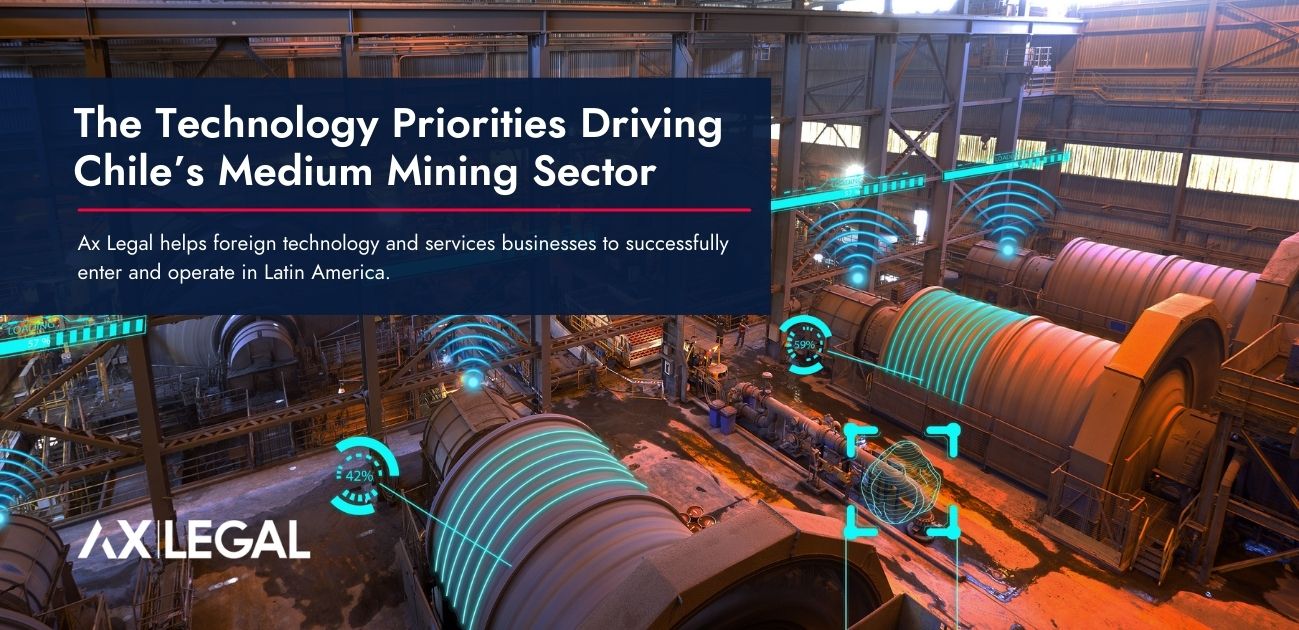
The Technology Priorities Driving Chile’s Medium Mining Sector
Chile’s mining narrative often centers on large-scale operations. Yet medium-sized mining plays a critical role in the country’s industrial ecosystem — particularly in regional development, employment generation, and productive diversification.
The Estudio de Vigilancia Tecnológica para la Mediana Minería (November 2025), developed by Corporación Alta Ley with support from Phibrand, offers a structured, data-driven assessment of how technology can strengthen this segment and close long-standing competitiveness gaps.
The study applied a rigorous funnel methodology, moving from broad technology scouting to classification by maturity and relevance, company-led prioritization, and early-stage economic evaluation. Out of 963 technologies identified, 136 were considered relevant to medium mining, 55 were classified as proven solutions, and 12 were shortlisted for deeper analysis. The result is a focused technology pipeline that supports disciplined investment decisions and reduces uncertainty around adoption.
This is not a theoretical or aspirational document. It is a practical investment roadmap.
Why This Study Matters
Medium-sized mining operates under tighter capital constraints, lower margins, and greater operational exposure than large-scale producers. It also faces infrastructure limitations and growing environmental and regulatory pressures.
In this context, modernization must be disciplined. The study’s objective was clear: identify technologies that are realistically implementable and prioritize those delivering the highest operational impact with feasible deployment.
Where Technology Is Concentrated — And Why It Matters
One of the most compelling findings of the study is where innovation is concentrated. The 136 identified technologies span the full mining value chain — from exploration and geological modeling to processing, logistics, and tailings management
Across these categories, a clear pattern emerges: operational efficiency under resource constraints. For medium-sized mining, where margins are tighter and capital is more limited, improvements in water efficiency, metallurgical recovery, or asset availability are not incremental gains. They are strategic enablers of competitiveness and long-term viability.
Water Optimization: Where Strategy Meets Survival
Water has emerged as one of the defining strategic variables for Chile’s mining sector. More than an operational input, water availability increasingly determines whether a mine can sustain production, expand capacity, or secure regulatory approvals. The recent technological surveillance study highlights a wave of solutions aimed at strengthening water efficiency in processing plants and tailings facilities. Among them are AI-driven systems that optimize recirculation from tailings storage facilities, predictive models capable of forecasting real-time water balances, evaporation mitigation technologies that reduce surface losses, and digital platforms that integrate operational monitoring with environmental reporting.
These technologies are not peripheral sustainability measures. They directly influence production stability, permitting exposure, and long-term operational resilience. For medium-sized mining companies in particular, even incremental gains in water recovery can significantly reduce freshwater intake, lower pumping and energy costs, and protect continuity during drought cycles. In this environment, water efficiency is no longer a compliance exercise. It is becoming a measurable source of competitive advantage.
Artificial Intelligence: From Reactive to Predictive Operations
Artificial intelligence and machine learning have emerged as another focal point in the modernization of Chile’s medium-sized mining sector. The study shows these technologies being deployed across core operational areas, from flotation optimization using multivariable sensors to predictive maintenance systems designed to improve asset availability. Additional applications include renewable energy forecasting for wind and solar generation, as well as advanced water balance simulation tools that allow operators to model different production and climate scenarios.
The shift is structural rather than incremental. Instead of reacting to lower recovery rates, unexpected equipment failures, or volatile energy prices, mining operations can increasingly anticipate variability and adjust in advance. Predictive flotation models help stabilize recovery while reducing reagent consumption. AI-driven energy forecasting reduces exposure to market fluctuations. Water modeling enables scenario planning before hydrological constraints become operational disruptions. In practical terms, these tools allow medium-sized mining companies to operate with a level of data-driven intelligence that was previously associated primarily with large-scale producers.
Digital Traceability: Control, Compliance, and Credibility
The study also points to the rapid development of digital ecosystems centered on real-time monitoring and operational traceability. These systems integrate continuous water and environmental monitoring, automated regulatory reporting, operational dashboards, and IoT-enabled sensor networks into unified platforms. Rather than operating with fragmented data streams, medium-sized mining companies can now access consolidated, live information across critical processes.
The benefits are immediate and practical. Real-time visibility supports faster, more informed decision-making, while structured digital reporting reduces regulatory exposure and compliance risk. In a context of heightened environmental scrutiny, traceability is no longer simply a reporting tool — it is a governance mechanism. By embedding transparency into daily operations, companies strengthen investor confidence and improve internal efficiency. In effect, transparency evolves into operational control.
Geological Modeling: Reducing Financial Risk at the Source
Early-stage geological uncertainty remains one of the most significant financial risks facing medium-scale mining projects. The study underscores the growing role of advanced geological modeling tools — including stochastic simulation software and machine-learning-driven exploration analysis — designed specifically to reduce that uncertainty.
These technologies enhance resource estimation accuracy, strengthen mine–plant reconciliation, improve integrated planning, and support more rigorous development risk assessment. The impact extends well beyond technical precision. Reducing geological uncertainty directly affects financing conditions, capital allocation decisions, and project sequencing. For medium-sized mining companies, where access to capital is often more limited and margins tighter, greater confidence in resource models can materially improve project economics and strengthen investment credibility.
Beyond Productivity: Efficiency as a Strategic Lever
Across water management, artificial intelligence, digital monitoring, and geological modeling, a consistent pattern becomes evident. The technologies prioritized in the study are not speculative or experimental concepts at the edge of the industry. They are practical, implementable solutions aimed at solving concrete operational challenges.
These tools are designed to increase recovery rates, reduce water and energy consumption, improve asset availability, and lower both operational and regulatory risk. In effect, they enable medium-sized mining companies to operate with greater resilience, discipline, and predictability. That is where the real transformation lies. Technology is no longer a discretionary upgrade or a branding exercise. It is becoming the operational foundation of competitiveness in Chile’s medium-sized mining sector.
Conclusion: A Strategic Entry Point for Foreign Technology Companies
The broader message of the report is clear: medium-sized mining in Chile is not technologically constrained — it is decision-constrained. The tools exist. What companies require is disciplined prioritization, measurable impact, and economically validated implementation.
For foreign technology companies looking to position themselves in Chile, this study provides a strategic roadmap.
First, it signals that technology adoption in medium mining must be structured and economically justified. Solutions that demonstrate clear ROI, staged deployment pathways, and operational validation will be significantly more attractive than large, open-ended transformation proposals.
Second, it highlights where demand is structurally concentrated. Water efficiency and energy optimization are not peripheral ESG topics; they are core competitiveness drivers. Technologies that reduce water intensity, stabilize energy costs, and improve resource efficiency address immediate operational pain points.
Third, predictive capabilities — whether in geology, processing, or maintenance — are viewed as financial risk-reduction tools. In a segment where access to capital is tighter, technologies that lower uncertainty can materially improve project bankability. Foreign providers who frame their solutions in terms of risk mitigation and financial impact will align more closely with local decision-makers.
The opportunity is clear. Medium mining is actively modernizing, but selectively. Foreign providers that align with these priorities and present financially grounded, implementable technologies are well positioned to compete in the Chilean market.
Ax Legal helps industrial technology, engineering, and service companies to navigate the legal and commercial aspects of operating their business in Latin America. With deep knowledge of the industrial and natural resource sectors, we provide actionable and practical advice to help streamline our clients’ entries into Latin America, improve how they operate in the region, and to protect their interests.
Over the years, our team of legal and commercial advisors have developed a track record of working with companies of all sizes from Australia, Canada, the U.S., and Europe. The one common factor that connects our clients is that they are leaders in their field, providing innovative technologies and services to the industrial sectors.
To better understand how we can support you in the Region, please contact Cody Mcfarlane at cmm@ax.legal

 Santiago
 Sydney
 Lima
Lima