
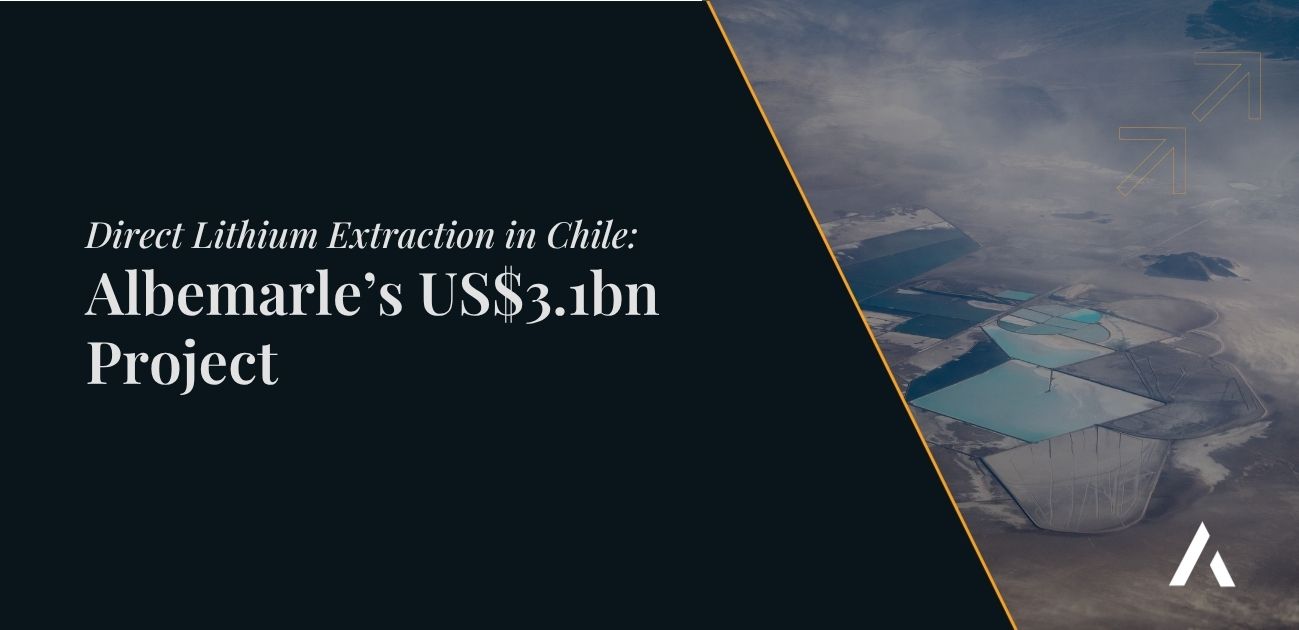
Direct Lithium Extraction in Chile: Albemarle’s US$3.1bn Project
Chile remains one of the world’s most important lithium jurisdictions. It is the world’s second-largest lithium producer, and commercial output still comes from just two operators in the Salar de Atacama: SQM and Albemarle. Despite this, the industry is far from straightforward. Lithium in Chile is strategically regulated, water use in the Atacama is heavily scrutinized, indigenous engagement is essential, and permitting has long been viewed by the mining sector as a major obstacle to new investment.
At the center of the current debate is Direct Lithium Extraction (DLE). Traditional lithium production in Chile relies on solar evaporation, a process that is efficient but water-intensive and slow. DLE, in contrast, aims to extract lithium directly from brine and reinject the remaining liquid back into the salar, potentially reducing environmental impact and improving recovery rates. However, while promising, DLE remains technically complex and largely unproven at scale in Chile.
Albemarle in Chile
Albemarle has operated in Chile for decades and is one of the country’s two lithium producers. Its brine is extracted at the Salar de Atacama and processed into lithium carbonate and lithium chloride at La Negra, near Antofagasta.
Its operations are governed by agreements with CORFO, Chile’s economic development agency. These agreements define production quotas, economic contributions to the state, and key operating conditions.
A critical development came in 2024, when CORFO granted Albemarle the option to increase its lithium production quota by 240,000 metric tons (LME), a significant increase from its existing quota. However, this increase is conditional. It requires:
- Adoption of more sustainable technologies
- Engagement with local communities
- Environmental approvals
Albemarle has also continued investing in Chile. Only a few years ago, the company inaugurated the La Negra III chemical conversion plant, an investment of more than US$500 million. Albemarle said that facility would double lithium production capacity at the plant level and reduce fresh water consumption per metric ton through a thermal evaporator.
The Project: Albemarle’s US$3.1bn DLE Investment
In March 2026, Albemarle formally submitted its “Transition to Direct Lithium Extraction” project to Chile’s environmental system. The project represents an investment of approximately US$3.1 billion and is located in the Salar de Atacama. Importantly, it is structured as a modification of existing operations rather than a greenfield development. The plan centers on the construction of a modular Direct Lithium Extraction (DLE) plant, which will include up to six processing trains, each capable of processing around 50 liters per second of brine, along with supporting infrastructure such as a power transmission line. Notably, the project does not involve expanding the operational footprint, as it does not include new extraction areas, additional evaporation ponds, or increases in permitted brine volumes.
From a technical perspective, DLE introduces a significant shift in the production process, focusing on efficiency and sustainability. The technology is expected to nearly double lithium recovery while significantly reducing brine extraction. It also allows for lithium-depleted brine to be reinjected back into the salar. Operationally, this could reduce extraction rates from current levels of approximately 442 liters per second to as low as 142 liters per second under full implementation. The project is currently undergoing environmental review through Chile’s SEIA system, will be developed in phases rather than as a single build-out, and has a projected operational life extending to around 2045. As with all major projects in Chile, the permitting process will be the key gating factor.
One of the most important points is that this is not just a concept note. Albemarle says the project is based on more than 10 years of research and development. It also states that it completed pilot testing at its La Negra facility, where the pilot plant operated for more than a year and achieved lithium recovery rates above 94%. The company says that work allowed it to optimize the process under operating conditions before scaling it up.
The Importance of DLE
This project is significant for several reasons. First, it represents a large investment in what is widely perceived as a cautious and slow-moving jurisdiction for mining and lithium projects. A US$3.1 billion commitment sends a strong signal that major players are still willing to invest in Chile and that the Salar de Atacama continues to be globally competitive.
Second, while Direct Lithium Extraction has been widely discussed, it has not yet been implemented at scale in Chile, making this one of the first serious commercial deployments and a real test case for the industry. If successful, it could redefine how lithium is produced in the country.
Third, the project aligns closely with Chile’s evolving regulatory direction, which is increasingly focused on sustainability, water management, and greater state involvement. In fact, access to additional production quotas is already linked to the adoption of technologies like DLE.
Finally, and perhaps most importantly, the project has the potential to unlock increased lithium production without requiring higher extraction rates. In a country where permitting new extraction is complex and time-consuming, this represents a meaningful structural advantage.
Conclusion
Albemarle’s DLE project in the Salar de Atacama is important not only because of its size, but because of what it signals for the future of lithium in Chile. The country has world-class resources, but development has been slow due to regulatory complexity, environmental pressure, and the technical challenges of operating in the salar.
This US$3.1 billion project is a clear attempt to move the industry forward with a different model: higher lithium recovery, lower net brine extraction, and no expansion of evaporation ponds. However, the real significance goes beyond Albemarle itself.
There is now an active race around which DLE technologies will actually work at scale in Chile. Multiple players are evaluating or piloting DLE solutions, but few have advanced to the level of a formal environmental submission. Albemarle is one of the first to take that step, which puts it ahead in both regulatory positioning and credibility.
This matters because access to future lithium production in Chile is increasingly tied to sustainability. The government is clearly pushing operators toward DLE, and companies that can prove it works will be better positioned to secure quotas, extend contracts, and partner with the state.
We are already seeing this dynamic with: SQM, which is evaluating DLE as part of its transition and its agreement with Codelco. ENAMI, which is advancing new projects with DLE as a core requirement New entrants and technology providers competing to supply viable DLE solutions
If Albemarle succeeds, it will likely set the benchmark for how future lithium projects in Chile are developed.
Ax Legal helps industrial technology, engineering, and service companies to navigate the legal and commercial aspects of operating their business in Latin America. With deep knowledge of the industrial and natural resource sectors, we provide actionable and practical advice to help streamline our clients’ entries into Latin America, improve how they operate in the region, and to protect their interests.
Over the years, our team of legal and commercial advisors have developed a track record of working with companies of all sizes from Australia, Canada, the U.S., and Europe. The one common factor that connects our clients is that they are leaders in their field, providing innovative technologies and services to the industrial sectors.
To better understand how we can support you in the Region, please contact Cody Mcfarlane at cmm@ax.legal

 Santiago
 Sydney
 Lima
Lima