
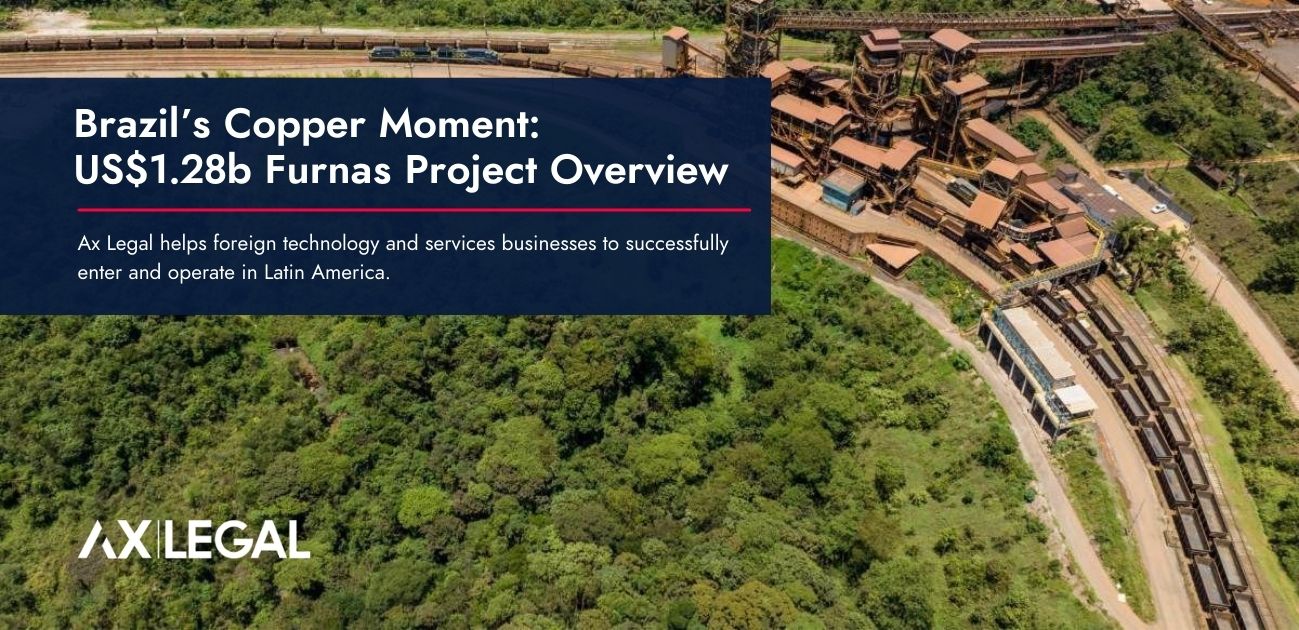
Brazil’s Copper Moment: US$1.28b Furnas Project Overview
Although Brazil has not traditionally been seen as a major copper producer, that perception is starting to shift. New exploration success in the Carajás district, together with a growing project pipeline and strong global demand driven by electrification and renewable energy, is positioning Brazil to the potential upside of copper over the coming years.
One of the most significant recent developments is the earn-in partnership between Ero Copper and Vale. Under this agreement, first announced in late 2023 and formalized in 2024, Ero can earn up to a 60 percent interest in the Furnas project by funding and advancing exploration, engineering, and development milestones over several years, while Vale retains a minority stake.
Ero has now released the inaugural Preliminary Economic Assessment for Furnas, outlining a 24-year open pit operation with the scale and economics to become a cornerstone copper asset in Brazil. In this article, we break down what the PEA tells us about the project’s size, investment requirements, production profile, and strategic importance.
Project Overview
The Furnas copper project is located in the Carajás Mineral Province in Pará, northern Brazil — one of the most prolific mining districts in the world and home to major copper operations such as Salobo. The project was originally part of Vale’s exploration portfolio, identified through regional exploration programs targeting large-scale copper-gold systems in Carajás.
According to the recently released Preliminary Economic Assessment (PEA), Furnas is designed as a large-scale, long-life open pit operation with an initial mine life of 24 years. During the first 15 years, the project is expected to produce on average:
- 70,000 tonnes of copper per year
- 111,000 ounces of gold per year
- 532,000 ounces of silver per year
This production profile equates to approximately 108,000 tonnes of copper equivalent annually, supported by strong gold and silver by-product credits that enhance overall economics. The scale and longevity outlined in the PEA position Furnas as a potentially significant new copper asset within Brazil’s evolving copper growth story.
Investment & Economics
The PEA outlines an initial capital expenditure of US$1.28 billion, covering full mine development, processing facilities, tailings infrastructure, and associated site works. With a capital intensity of approximately US$16,000 per tonne of copper equivalent, the project is competitive for a greenfield copper development of this scale and 24-year mine life.
Using long-term price assumptions of US$4.60/lb copper and US$3,300/oz gold, the study delivers an after-tax NPV (8%) of US$2.0 billion, an IRR of 27%, and a 3.1-year payback period. These figures point to strong project economics, particularly given the size of the upfront investment and the long-term production profile.
What the Capex Covers
The estimated US$1.28 billion initial capital will fund the full construction of a standalone open pit mining operation. This includes mine pre-stripping and fleet acquisition, construction of a concentrator plant with crushing, grinding and flotation circuits, and development of a tailings storage facility. The investment also covers water management systems, power connection and substations, on-site infrastructure such as workshops and maintenance facilities, as well as access roads and logistics integration within the Carajás region.
Development Strategy
With the release of the Preliminary Economic Assessment, the Furnas project now moves into a more detailed technical and permitting phase. Over the next 12 to 24 months, Ero Copper Corp. plans to focus on advancing the project through a structured de-risking program designed to support future development decisions.
Key priorities during this phase include:
- Additional drilling to further define and potentially expand the mineral resource, improve confidence levels, and convert resources into higher categories where possible.
- Engineering optimization, refining mine design, production schedules, and plant configuration to improve efficiency and capital allocation.
- Metallurgical validation, confirming recovery assumptions and optimizing the processing flowsheet to maximize copper, gold, and silver recovery.
- Environmental studies and permitting, progressing baseline work and regulatory submissions to support future construction approval.
- Infrastructure and site layout refinement, including tailings design, water management planning, and logistics integration within the Carajás district.
Importantly, these activities are directly tied to Ero’s earn-in agreement with Vale S.A.. By funding and advancing these milestones, Ero is working toward securing a 60 percent ownership stake in the project. This phased development approach allows the company to reduce technical, environmental, and capital risks before committing to full construction, while steadily increasing its interest in what could become a major new copper operation in Brazil.
Conclusion
Furnas represents more than a single project — it signals a broader shift in Brazil’s copper story. Located in the Carajás mineral district, one of the world’s most established copper provinces, the project combines a 24-year mine life, strong gold and silver by-product credits, competitive capital intensity, and robust economic returns. If advanced to construction, Furnas would materially expand Ero Copper Corp.’s production profile and position the company as a significantly larger copper producer in Brazil, with a diversified revenue stream and meaningful exposure to energy transition metals.
More broadly, Furnas highlights the growing pipeline of copper investments in Brazil. Established operations such as Salobo, ongoing expansions in the Carajás district, and advancing projects like Boa Esperança and Chapada demonstrate increasing capital allocation toward copper. As global demand for electrification, grid infrastructure, and renewable energy continues to rise, Brazil’s combination of geological scale, infrastructure, and mining expertise positions it to play a larger role in future copper supply. Projects like Furnas may well be the early indicators of a new investment cycle in Brazilian copper
Ax Legal helps industrial technology, engineering, and service companies to navigate the legal and commercial aspects of operating their business in Latin America. With deep knowledge of the industrial and natural resource sectors, we provide actionable and practical advice to help streamline our clients’ entries into Latin America, improve how they operate in the region, and to protect their interests.
Over the years, our team of legal and commercial advisors have developed a track record of working with companies of all sizes from Australia, Canada, the U.S., and Europe. The one common factor that connects our clients is that they are leaders in their field, providing innovative technologies and services to the industrial sectors.
To better understand how we can support you in the Region, please contact Cody Mcfarlane at cmm@ax.legal
 Santiago
 Sydney
 Lima
Lima