
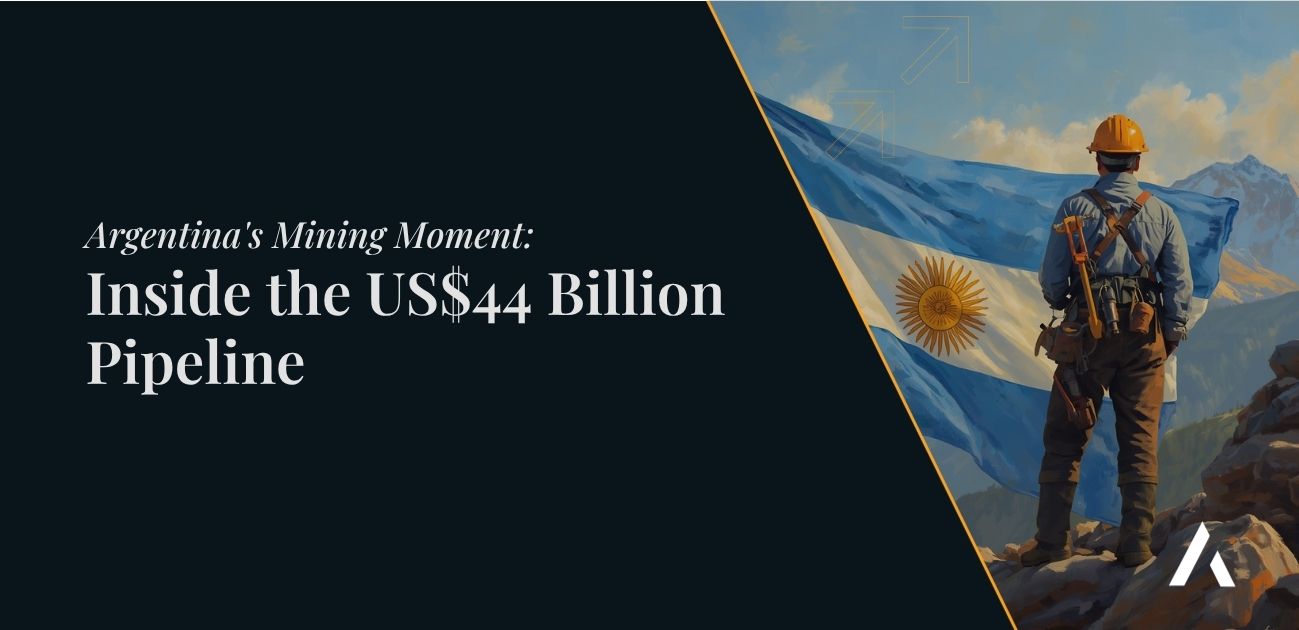
Argentina’s Mining Moment: Inside the US$44 Billion Pipeline
Argentina has quietly become one of the most important mining stories in the world, and 2026 is the year it stops being quiet. The country closed 2025 with a record US$6.06 billion in mining exports, 30% above the prior year, and is on track to reach US$9 billion in 2026, a 49% jump driven by copper, lithium, gold, and silver. Behind that headline number sits something bigger: a pipeline of twenty projects representing roughly US$44 billion in committed and proposed investment, anchored by names like Lundin, BHP, Glencore, Rio Tinto, McEwen, and First Quantum. For mining equipment, technology, and service companies, Argentina is quickly moving from the “watch list” to “act now.”
What Changed: Policy, Politics, and Capital
The single biggest catalyst is the RIGI (Incentives Regime for Large Investments), enacted in 2024 and now the centerpiece of Argentina’s pitch to global capital. For any project over US$200 million, RIGI locks in 30 years of fiscal, customs, and foreign-exchange stability, cuts income tax from 35% to 25%, allows free repatriation of foreign currency after three years, and streamlines imports of machinery. That combination directly addresses the two things that historically scared investors away from Argentina — tax unpredictability and capital controls. Applications run through July 2027, and roughly US$9 billion has already been approved, with billions more under review. In May 2026, President Milei went further, announcing a forthcoming “Super RIGI” aimed at pulling capital into mineral processing, battery manufacturing, and other downstream industries that barely exist in the country today.
The regulatory wins didn’t stop at incentives. In April 2026, Congress passed a long-debated reform to the Glacier Protection Law, narrowing automatic federal protection to glaciers with a proven hydrological function and handing provinces authority over periglacial zones. In practical terms, the reform unlocks high-altitude acreage in San Juan and Salta that had been stuck in legal limbo, including ground relevant to El Pachón, Los Azules, and the Vicuña district. The macro backdrop reinforces the shift: GDP grew 4.4% in 2025, capital controls were largely lifted, inflation is moderating, and the IMF projects 3.5% growth for 2026, with mining and energy leading the recovery. It’s worth being clear-eyed, though, environmental groups have vowed to challenge the Glacier reform in court, and the regime still leans heavily on continuity of the current political direction.
San Juan: The Copper Megaproject Hub
San Juan is the heart of the copper story. Mining already accounts for 85% of the province’s exports, and it hosts four of the country’s largest copper projects.
The crown jewel is the Vicuña District, a Lundin Mining–BHP joint venture straddling the Argentina–Chile border (the Josemaría deposit in San Juan, Filo del Sol in Chile’s Atacama region). At full throughput it’s designed to produce more than 500,000 tonnes of copper a year, which would rank it among the top five copper-gold-silver mines on the planet. Total investment across three stages runs to US$18.2 billion. Stage 1 alone (US$7.1 billion) targets construction starting in early 2027 and first production in June 2030, and Lundin has already lined up a US$4.5 billion credit facility to fund it. A final investment decision is expected by late 2026.
Los Azules (McEwen Copper) was the first copper project to win RIGI approval, in September 2025, with a US$2.67 billion approved investment. It’s now in detailed engineering, targeting an FID by the end of 2026, construction in early 2027, and first production in January 2030 — averaging around 205,000 tonnes of copper cathode a year in its first five years using a heap-leach / SX-EW process. Rio Tinto, already a partner through its Nuton technology, is weighing an increase to its stake.
El Pachón (Glencore) is the largest single-project investment in the entire pipeline at US$9.46 billion, targeting 338,000 tonnes of copper a year over a 40-year life. It’s still awaiting RIGI approval and faces the heaviest pre-construction infrastructure bill of any project — a new concentrator, a long transmission line, and a logistics solution for moving concentrate to port. Construction is targeted from 2029, with production in 2034. Rounding out the province are Altar (Aldebaran/Sibanye, US$1.6 billion, copper-gold, heading toward a 2027 RIGI application) and the operating Veladero gold mine (Barrick/Shandong), which secured RIGI backing for a US$400 million life-of-mine extension.
Jujuy: Argentina’s Lithium Engine
Jujuy leads the country in lithium, where brine operations account for 80% of provincial exports. The anchor is Cauchari-Olaroz, operated by Exar (Ganfeng, Lithium Argentina, and provincial company JEMSE), the country’s largest operating lithium brine mine. It produced 34,100 tonnes of lithium carbonate in 2025 and is now expanding: a US$1.24 billion Stage 2 using direct lithium extraction (DLE) technology won RIGI approval in May 2026 and will lift total capacity to 85,000 tonnes a year, with first production targeted for early 2029. The province’s road and rail links to Chile’s Port of Antofagasta give it a logistics edge most projects don’t have. Nearby, Solaroz, now controlled by China’s CNGR after acquiring the original Australian developer — sits in earlier-stage development at a planned US$987 million.
Salta and Catamarca: Lithium Scale and a Copper Heavyweight
The two provinces flanking Jujuy carry a mix of advanced lithium operations and one of the country’s biggest copper plays.
In Salta, Taca Taca (First Quantum) is a US$5.25 billion copper-gold-molybdenum project targeting roughly 291,000 tonnes of copper a year. The company signed an agreement with the IFC in 2026 to align with international ESG standards, a move aimed at lowering its cost of capital — with construction expected from April 2027. Also in Salta, Rio Tinto’s Rincón is one of the few large lithium projects already under construction (US$2.74 billion, 60,000 tonnes a year), with full operations expected by 2031, and Eramet’s Centenario-Ratones (US$870 million, DLE) is in ramp-up, having hit around 75% of nameplate capacity by late 2025.
In Catamarca, Glencore’s MARA project (US$4 billion, 156,000 tonnes of copper a year) is in environmental evaluation, with the company reactivating the adjacent Alumbrera mine by end-2026 as a de-risking step. Rio Tinto’s operating Fénix mine secured RIGI approval for a US$530 million expansion, and Galan Lithium’s Hombre Muerto West is pivoting to sell lithium chloride concentrate directly rather than processed carbonate. On the Salta-Catamarca border, AbraSilver’s Diablillos silver-gold project won RIGI approval in March 2026 and is targeting a construction start in mid-2026.
Why the Chile Border Is the Whole Game
Here’s the geographic reality that shapes everything: most of Argentina’s future mining production will leave the continent through Chilean Pacific ports, not Argentine Atlantic ones. The Andean mineral belt simply sits closer to the Pacific, and that makes cross-border infrastructure the central variable in how fast this pipeline actually moves.
The clearest example is Vicuña itself, the most prominent binational mining initiative in South America. Its design depends on a desalination plant on the Chilean coast (2,000 litres per second), a 200-kilometre water pipeline running up to the mine, and slurry and concentrate pipelines feeding Chilean ports. It will operate under the 1997 Argentina-Chile bi-national mining treaty — the same framework Veladero has used for years.
Beyond Vicuña, three Pacific corridors are being built or upgraded to carry the coming wave of exports. The most urgent is Route 51 / Paso de Sico, connecting Salta to Antofagasta, where the Inter-American Development Bank committed US$100 million in 2026 to pave the remaining unpaved stretches — once finished, the route is expected to handle around 700 trucks a day. The San Francisco Pass links Catamarca to Atacama, and the broader Capricorn Bioceanic Corridor ties northern Chilean ports to São Paulo. On the coast, Chile is investing in the ports of Punta Caldera and Copiapó (a US$300–500 million program), partly to compete with Peru’s new Chinese-backed Port of Chancay for regional mineral flows. Energy is the other half of the equation: a planned US$250–400 million transmission line by YPF Luz and Central Puerto would finally bring reliable clean power to the grid-starved Puna, though it still needs offtake agreements before it can be built.
Conclusion
By the mid-2030s, Argentina could sit among the world’s top five copper exporters and top three lithium producers — and the foundations for that are already being poured. This is a structural transformation, not a cyclical one. RIGI built a credible, bankable framework, the Glacier reform removed a major legal overhang, and the elite deposits across San Juan, Salta, Catamarca, and Jujuy now have serious money committed against them.
The risks are real and worth naming: pending court challenges to the Glacier reform, the absence of a national mine-closure law, water scarcity at altitude, energy gaps in the Puna, and an infrastructure buildout that is the single biggest determinant of timing. But the direction of travel is unmistakable. The next three years are dominated by financing decisions, permitting, and construction starts, which means demand for everything that surrounds a mine — road and camp construction, water and energy systems, processing equipment, concentrate transport, port handling, and the legal and regulatory groundwork that ties it all together — is about to grow across an entire decade. For investors and companies who have been waiting, the moment to act is now arriving.
Ax Legal helps industrial technology, engineering, and service companies to navigate the legal and commercial aspects of operating their business in Latin America. With deep knowledge of the industrial and natural resource sectors, we provide actionable and practical advice to help streamline our clients’ entries into Latin America, improve how they operate in the region, and to protect their interests.
Over the years, our team of legal and commercial advisors have developed a track record of working with companies of all sizes from Australia, Canada, the U.S., and Europe. The one common factor that connects our clients is that they are leaders in their field, providing innovative technologies and services to the industrial sectors.
To better understand how we can support you in the Region, please contact Cody Mcfarlane at cmm@ax.legal


 Santiago
 Sydney
 Lima
Lima