
Brazil Labour Law: Ending the Six-Day Week
Labour law is often the first real surprise for foreign companies in Brazil.
The rules are detailed and strongly protective of workers. Hours, overtime and rest are set not just by the employment contract, but by the Constitution, the labor code, union agreements for each sector and the data you report to the government every month. A schedule that works in Australia or Canada can breach Brazilian law, and a policy from headquarters does not override local rules. Small mistakes in payroll or time records can become overtime claims years later.
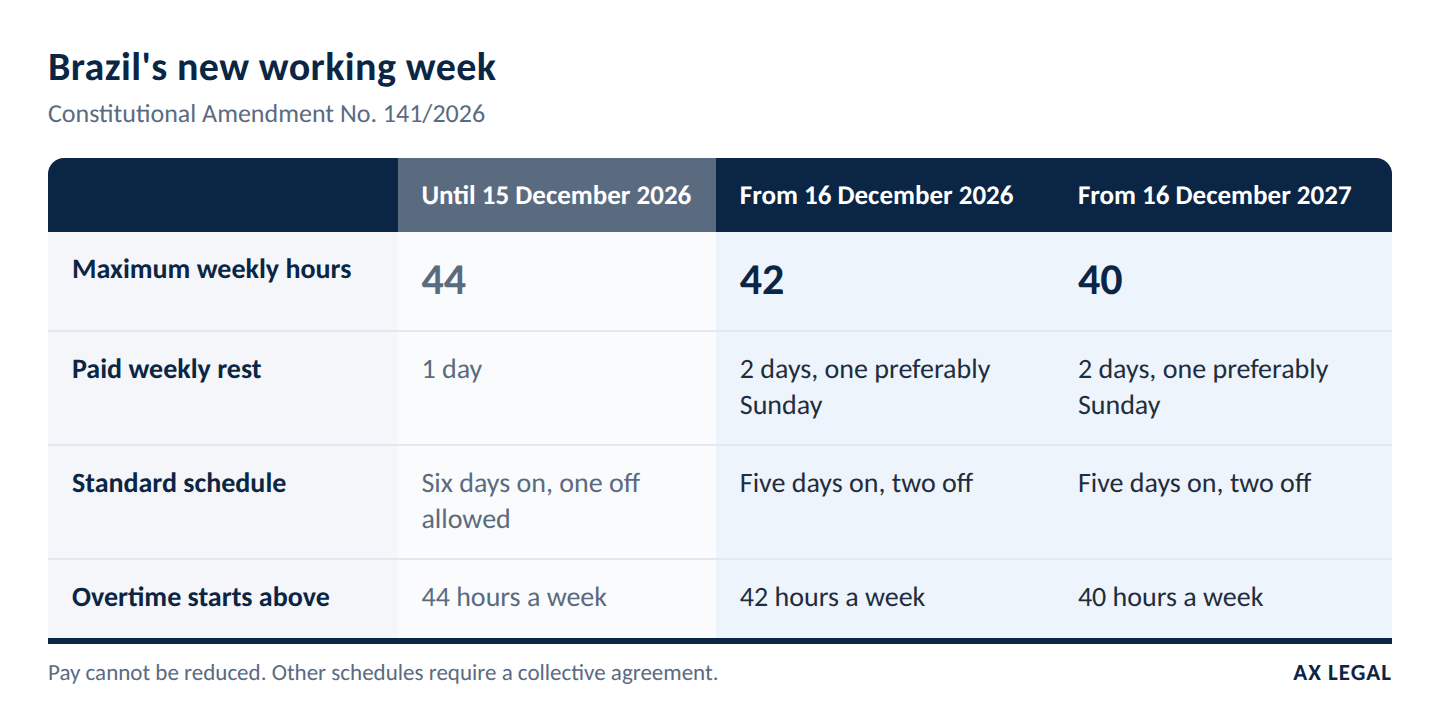
Now the rules are changing again. On 16 October 2026, Brazil’s Congress amended the Constitution to end the six-days-on, one-day-off schedule, known locally as “6×1”. From 16 December 2026, every employee gets two paid rest days a week and the maximum working week drops from 44 to 42 hours, then to 40 hours in December 2027. Pay cannot be cut.
This applies to every company with employees in Brazil, including foreign-owned ones. If you have a team there, you have about eight weeks to adjust. Here is what you need to know.
What changes, and when
A few other rules matter:
- Pay is protected. Monthly salaries, including category minimum wages, cannot be reduced because of the shorter week.
- Other schedules need a union agreement. Anything other than five days on and two off is only allowed under a collective agreement, and an individual agreement with the employee is not enough.
- Existing union clauses can fall away. Collective agreement clauses on working hours or rest that conflict with the new rules stop applying on 16 December 2026.
- Public-sector contractors get more time. Companies supplying outsourced services to government entities have until 16 October 2027 to adapt.
It is not only about six-day schedules
The name of the reform suggests it only affects retail and service workers. It goes further.
- Five-day weeks at 44 hours. Many companies already give two days off but spread 44 hours from Monday to Friday, at roughly 8 hours and 48 minutes a day. They must also cut to 42 hours in December 2026 and 40 hours in December 2027.
- Shift-based operations. Mining sites, processing plants, energy assets and field service teams often run rotating shifts or 12-hour shifts followed by 36 hours off. These patterns, along with hour banks and weekly compensation schemes, were designed around the 44-hour limit and need to be reviewed.
- Expatriates on local contracts. Foreign staff hired under a Brazilian employment contract follow the same rules as everyone else.
If your contracts are already at 40 hours or less, hours do not need to fall further, but employees must still receive two rest days a week.
Unions, payroll and compliance
- Collective bargaining is now on the critical path. Three decisions require an agreement with the relevant union: keeping any schedule other than five days on and two off, extending daily hours during the 42-hour phase, and replacing union clauses that stop applying in December. With only weeks to go, those conversations need to start now.
- Payroll has to change twice. Every change in working hours must be documented in the employment contract and reported through eSocial, Brazil’s mandatory digital platform for employment and payroll data, before it reaches payroll. The December 2026 payroll will cover two regimes: 44 hours until 15 December and 42 hours from 16 December. The whole cycle repeats for the move to 40 hours in December 2027.
- Inconsistencies create risk. Hours reported to the government must match the employment contract, the collective agreement and the time-keeping system. Mismatches are a common trigger for labor inspection findings and a frequent source of evidence in labor claims. Unpaid overtime also carries knock-on effects on vacation pay, the 13th-month salary, the government severance fund and social security contributions.
What to do before December
- Map your people. Identify everyone working more than 40 hours a week, including shift workers and expatriates on local contracts.
- Check your union agreements. Know which collective agreement applies and what it says on hours and rest.
- Decide your new schedule by November. Open union talks now if you need anything other than five days on and two off.
- Implement by 15 December. Update contracts, time-keeping, payroll and eSocial.
- Budget for 2027. Plan the move to 40 hours now, not next December.
Conclusion
The end of the six-day week is a major change, and Brazil has given companies very little time to prepare. For foreign companies, the rule itself is not the main risk. The risk is a decision that sits too long at headquarters, a union conversation that starts too late, or a payroll that no longer matches the contracts.
For mining services, technology and energy companies, the impact is sharper. Field teams, site rotations and round-the-clock operations do not fit neatly into a standard five-day week, and changing them takes planning, union agreement and clean records.
Companies that move in the next few weeks can control the cost and the transition. Those that wait will be fixing it under pressure.
Ax Legal helps industrial technology, engineering, and service companies to navigate the legal and commercial aspects of operating their business in Latin America. With deep knowledge of the industrial and natural resource sectors, we provide actionable and practical advice to help streamline our clients’ entries into Latin America, improve how they operate in the region, and to protect their interests.
Over the years, our team of legal and commercial advisors have developed a track record of working with companies of all sizes from Australia, Canada, the U.S., and Europe. The one common factor that connects our clients is that they are leaders in their field, providing innovative technologies and services to the industrial sectors.



 Santiago
 Sydney
 Lima