
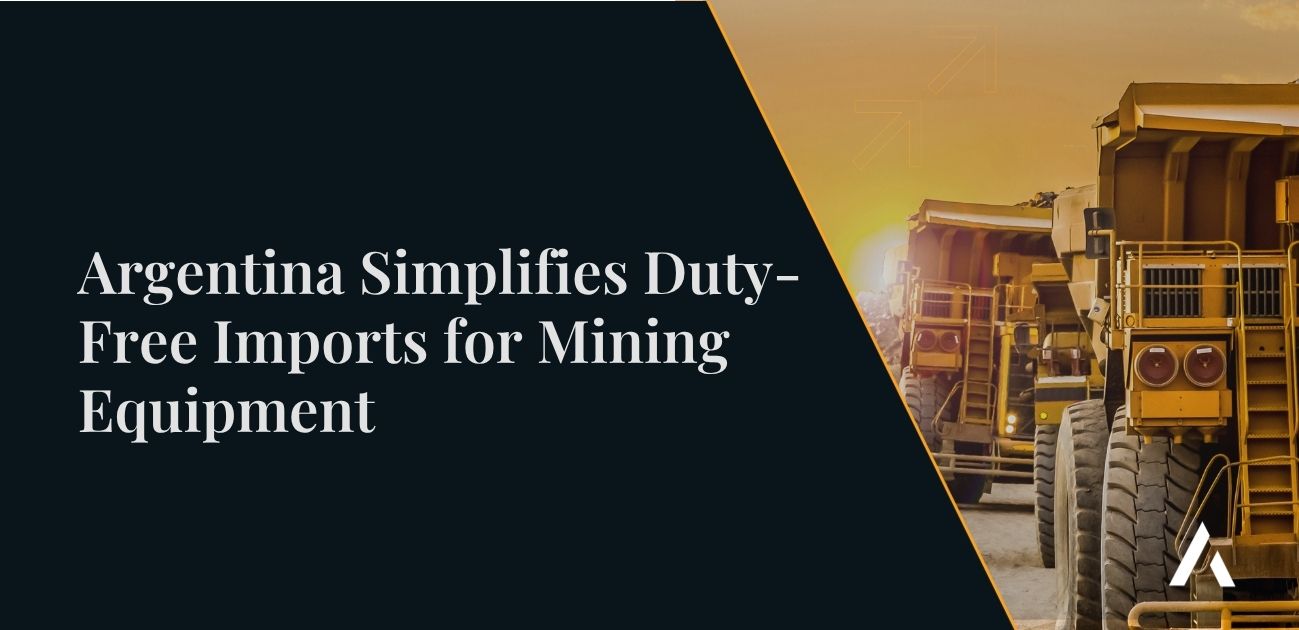
Argentina Simplifies Duty-Free Imports for Mining Equipment
Argentina’s Mining Investment Law (Law 24,196) has long allowed registered mining companies and mining service providers to import qualifying capital goods, spare parts and inputs free of import duties and the statistics fee.
The problem was not the benefit itself, but accessing it. The previous system required case-by-case prior approvals, which often caused delays at exactly the wrong time: when equipment was needed for a project, commissioning or deployment.
Resolution 73/2026 changes that model. Prior authorizations are replaced by digital sworn statements, with traceability through the TAD platform, VUCEA foreign trade window and Customs’ SIM system. The goal is to move from prior approval toward digital declaration and subsequent control.
How the new process works
- The company files a sworn statement of mining destination through TAD, covering up to 30 items per operation.
- The Dirección de Inversiones Mineras has five administrative business days to review it.
- Once admitted, it is sent through VUCEA for validation in Customs’ SIM system.
- Goods must generally match the approved tariff list. Items outside the catalogue may require a technical report from an independent engineer.
- Used equipment requires a fitness certification, while reconditioned equipment requires additional technical certification.
- The rules also address leasing, temporary export for repairs, transfers between qualifying projects and the eventual removal of goods from the regime.
In practical terms, this should make mining imports faster and more predictable. A drilling contractor with a rig ready to move into Argentina, for example, should no longer face the same type of individual prior authorization process before the equipment can enter.
Registration is still essential
There is one important condition that has not changed: the company must be registered under Law 24,196. The duty exemption is only available to companies admitted to the Mining Investment Regime through the Registro de Inversiones Mineras (RIM). When an import is submitted, the authorities check that:
- the company’s registration is current;
- the goods are connected to an active mining project or declared mining service; and
- the relevant project remains active.
- The digital declaration is therefore only one part of the process. It must match the company’s registry information.
Who can register?
The regime covers both:
- Mining producers: companies that own or operate mining projects.
- Mining service providers: contractors that directly support mining projects.
This can include drilling contractors, blasting companies, engineering firms, equipment maintenance providers and other technical service companies. A company does not need to own mining rights to qualify as a service provider, but its mining activities need to fall within its corporate purpose and be properly documented.
For a newly incorporated Argentine subsidiary, this means the company should be structured correctly from the beginning. For example, if an Australian drilling company establishes in Argentina, its corporate purpose should clearly allow it to provide drilling and related mining services. Waiting until the first rig is already being shipped is too late to start thinking about registration.
Registration must remain current
Registration is not a one-time exercise. Beneficiaries must keep their annual filings current and maintain active projects and services in the registry.
This matters even more under the new digital system because registration status is checked when each import is processed. A late filing can therefore become an operational issue. A company may have a machine or critical spare part arriving at port only to discover that its registration is not current.
Why this matters for mining suppliers
The practical benefits go beyond faster paperwork.
- Faster imports – Under the old system, a drill rig, crusher or processing unit could be ready to ship while the company was still waiting for approval. Under the new process, the company files digitally and the authority has five administrative business days to review the declaration.
- Better predictability – Because the benefit is linked to an approved list of tariff positions, companies can assess earlier whether their equipment qualifies. That is useful when pricing a tender or deciding whether to move equipment into Argentina.
- Used and reconditioned equipment – Used and reconditioned machinery can qualify, subject to the applicable technical certifications. This is particularly relevant to drilling companies and mining contractors that regularly move fleets between countries rather than purchasing new equipment for each project.
- Local spare-parts inventory – Mining service providers can use their own warehouse as a provisional destination for qualifying parts, spares, accessories and inputs. For example, a company maintaining mining equipment across several sites may be able to hold common spare parts in Argentina and allocate them to a project once they are required. If the goods are not assigned to a qualifying mining service within the required period, the company must begin the process of removing them from the regime and paying the applicable taxes.
- Moving equipment between projects – Equipment can also be moved between qualifying projects of the same owner or certain related companies without losing the benefit. That is particularly useful for contractors operating across mining regions such as San Juan, Salta, Catamarca and Jujuy. A machine finishing work at one project may be reassigned to another rather than being treated as a completely new import.
- Leasing – The new rules also allow qualifying imports through leasing structures, subject to the required declarations and liability rules. This can be useful for companies that want to deploy equipment in Argentina without purchasing the full fleet locally.
What foreign mining companies should do
For a foreign mining contractor or technology company entering Argentina, the practical sequence is:
- Incorporate the local company with the correct mining activities in its corporate purpose.
- Obtain the CUIT.
- Register under the RIM.
- Keep the registration and annual filings current.
- Confirm that the equipment and tariff classifications qualify.
- Use the new digital import process.
For companies already operating in Argentina, the first step should be to confirm that their RIM registration and annual filings are current before relying on the new procedure. The reform is a meaningful improvement for mining service and technology companies. It should make it easier to move equipment, spare parts and technical assets into Argentina, but the benefit still depends on having the local company, registration and compliance properly structured.
Ax Legal helps industrial technology, engineering, and service companies to navigate the legal and commercial aspects of operating their business in Latin America. With deep knowledge of the industrial and natural resource sectors, we provide actionable and practical advice to help streamline our clients’ entries into Latin America, improve how they operate in the region, and to protect their interests.
Over the years, our team of legal and commercial advisors have developed a track record of working with companies of all sizes from Australia, Canada, the U.S., and Europe. The one common factor that connects our clients is that they are leaders in their field, providing innovative technologies and services to the industrial sectors.
To better understand how we can support you in the Region, please contact Cody Mcfarlane at cmm@ax.legal


 Santiago
 Sydney
 Lima
Lima